

Datong — Where Stone Buddhas Watch Over the Northern Wind
The first thing you notice in Datong (大同市) isn’t the skyline — it’s the air. Cool mountain wind slips between the tiled rooftops, carrying the faint scent of incense and coal, a reminder that this city has balanced faith and industry for centuries. Shanxi Province’s “north gate” (山西北大门) has seen dynasties rise, armies march, caravans pause on the Silk Road’s northern branch.
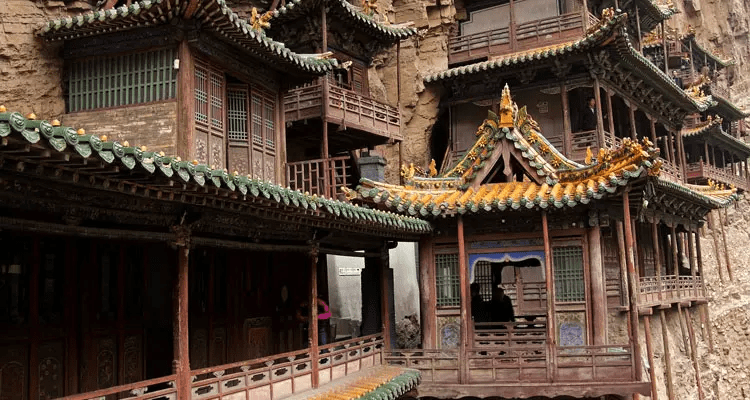
Today, trains glide in from Beijing in under two hours, but step beyond the station and it’s the 5th century that greets you — towering stone Buddhas at the Yungang Grottoes (云冈石窟), cliff-hugging halls of the Hanging Monastery (悬空寺), and streets where locals still trade oat noodles and sesame flatbreads like their grandparents did.
Datong isn’t a quick photo stop. It’s a place that settles into your skin — part mountain chill, part incense haze, part echo of prayer in temple halls that have stood for a thousand years.
Location & Accessibility — Datong, Where Time Takes a Breather
You step off the bullet train and the air shifts—thick with incense, mountain wind, and just a hint of coal smoke. Datong (大同市), nestled in Shanxi Province (山西省), is that breathing space between “Beijing hustle” and “ancient heart.” Official stats say it’s 350 km from Beijing, but travel by high-speed train (about 2 hours) makes it feel like ten minutes to another world.
Wikipedia
Local Chinese travel blogs (like those on Ctrip and Mengxiangjian) rave that Datong is the best “serious culture immersion” within easy reach: one minute wrapped in modern metro, next in the echo of mountain-carved Buddhas.
intothebloom.comtrip.com
Once you hit Datong South Railway Station, you’ve got three lanes of local access lined up:
- Subway shortcut → shared bike: pedal into the Old Town past soot-streaked walls and noodle stalls.
- DiDi or local ride-share: the quickest way to get up those steep pagoda lanes, no calf strain required.
- Chartered van: because you’ll need it if you’re mapping the Hanging Temple or Mount Heng in one day.
sign.hakka.gov.tw+15chinahighlights.com+15booked.ai+15booked.ai+1intothebloom.com+1
Need options? Datong Airport (大同云冈机场) is just 40 minutes out if you’re coming from farther cities—perfect for hopping into history without a train ticket tantrum.

Historical Significance: Where Dynasties Carved Their Echoes in Stone
Imagine strolling under the sweep of ancient city walls, feeling more curiosity than concrete. Datong—once called Pingcheng (平城)—has worn more roles than a touring actor: capital city, strategic fortress, Buddhist haven, and cultural crossroads. And there’s a reason local blogs and historians still get misty when they mention it.
- Capital of Northern Wei (398–494 CE): When the Xianbei moved their seat here, they didn’t just build a city—they built a stage for cultural fusion. Within those walls, steppe embraced Han bureaucracy, spawning wonderfully strange art like the Yungang Buddhas.
Gone like the wind - Three Capitals, One Legacy: Long after the Wei dynasty receded, Datong kept popping up in history. It served as a western capital (Xijing) for the Liao and Jin dynasties—a springboard for power, not the back row.
m.news.xixik.com - Walls That Talk: The city walls you walk today are Ming-era rebuilds over Wei foundations, complete with watch towers and a moat. These are centuries-old defense lines kept alive through modern restoration.
- Frontline Fortress: Over centuries, Datong was less tourist detour and more strategic bullseye. It was a Nine Frontier Town during the Ming–Qing period, a fortress between nomadic waves and imperial commands.
- Living Relics: Step away from the cliff temples and dig deeper—and you’ll hit memorials like Fangshan Yonggulings (方山永固陵), the burial tomb of Empress Feng (488 CE) that survived looting, excavation, and bureaucracy.
These aren’t bullet points—they’re time-ripple markers. When you walk Datong’s heritage sites, you’re not just seeing history—you’re inhaling dynasties, footnotes, and coal-fired prayers at once.
Unique Features & Vibe: Datong’s Coal Dust & Candlelight Song
You breathe in Datong and it tastes like incense and coal. Stone Buddhas catch your eye, but it’s the cluttered back alleys, neon signs over crumbling walls, and the stray noodle steam that glue the city to your senses. There’s grit here—authentic, unapologetic.
- Cultural Merge-Haven: In the old city’s East-Southeast Yi Historic & Cultural District (东南邑历史文化街区), you feel the hush of art exhibitions, the flow of ceramics, and galleries pushing legend meets local. Locals say strolling past the “蓝印东方” ceramic shops feels like walking into a live museum.
Trip.com+1 - Dining with Stories: Noisy noodle shops sit beside the official heritage sites. A bowl of sliced noodles or bean jelly tastes like centuries of coal and ceremony. Don’t skip the “刀削面” — called the “面食王中王” by locals for a reason.
Wikipedia - Modern Legends, Real Gravity: Walk into the 煤机房酒吧 (Coal Machine Room Bar) and the brutalist bricks and exposed beams will swallow your city-filters. Think warehouse romance with neon shadows — no filter required.
zovps.com - Evening Legends: Around Cloud Dragon Nine-Dragon Wall (九龙壁)—a glaze-glow spectacle—locals line up under lanterns and street performances during Lunar New Year. Tourists come for the dragon murals, stay for the local luck and laughter.
qinshui.gov.cn - Cultural Resurgence: New artistic life pulses at Heyang Art Museum (和阳美术馆). A 4D art crash course next to the restored city wall. You can watch digital projections flicker through millennia-old sentiments in half-waking dreams.
Visitor Information: How to Do Datong Without Looking Lost
Insider Timing
Go to the Nine-Dragon Wall (九龙壁) right after lunch — tour buses leave for other sites and the golden afternoon sun turns those ceramic dragons into molten jewels.
Opening Hours & Timing
Most sites play by the old-school museum clock — open at 08:00, lock the gates between 17:00–18:00. Don’t push it. Security guards here don’t “soft close” — they’ll literally herd you toward the exit like you’re late for curfew.
Tickets & Bundles
Yungang Grottoes (云冈石窟) — around ¥120 in peak season, worth every yuan for the stone serenity alone. Hanging Monastery (悬空寺) — ¥125, and yes, you’ll pay that just to freak yourself out walking those cliffside planks. Yingxian Wooden Pagoda (应县木塔) — about ¥60; the smell of ancient timber is free. Tip: Some hotels partner with local agencies offering bundle tickets — check with your concierge instead of blindly lining up with bus tours.
Entry Etiquette
In temples, shoes stay on the ground outside — not on the sacred wooden floors. Dress modestly — no “I just came from the club” outfits. Locals don’t expect you to know the rituals, but they notice if you steamroll through prayer spaces without pausing.
Photography Rules
Cameras? Often fine. Flash? Absolutely not. Inside grottoes, flash photography is the fastest way to get side-eyed by both the guides and the Buddhas.
Survival Props
Tissues & Wet Wipes — Not just for bathrooms (though yes, you’ll need them there), but also for Yungang’s slightly damp, cave-like air. Locals swear it helps keep the stone dust and chill off your nose.
Cash — While Alipay (支付宝) and WeChat Pay (微信支付) dominate, smaller street food vendors near the city wall still love the rustle of actual bills.
Wind Gear — Datong’s spring and autumn winds will slap your face without warning. A light scarf can save your skin and your hair in photos.

Nearby Attractions & Side Trips: Because Datong’s Not Your Only Playground
Off-beat Mountain Temples
Beyond the tourist-heavy monasteries, tiny ridge-top temples like Yanmenguan Pass Temples (雁门关寺庙) offer panoramic views with barely a soul around. The hike up is quiet enough to hear your own footsteps — and the occasional hawk circling above.
Pingyao Ancient City (平遥古城)
About 2–3 hours by high-speed rail, this UNESCO darling is all cobblestone lanes, red lanterns, and the kind of city wall you can still walk without a hardhat. The old banks and courtyard homes are Instagram candy, but the real charm is in the smoky alleyway grills serving cumin lamb skewers till midnight.
Mount Heng (恒山)
Roughly 1 hour’s drive from Datong, this is one of Taoism’s Five Sacred Mountains — and it’s not just the cliffside Hanging Monastery here. The upper trails are quiet, pine-scented, and occasionally shrouded in fog thick enough to erase the path behind you. Pack layers — even in summer, Hengshan likes to throw shade in the form of wind chill.
Guangling Ancient City (广灵古城)
A less-touristed town about 90 minutes away where you’ll find ancient gates and courtyards without the selfie-stick battalions. Locals sell hand-pulled noodles right from street-front kitchens — the kind that slap the counter loud enough to make you turn your head.
Yingxian Wooden Pagoda (应县木塔)
Already on most Datong itineraries, but worth a separate day if you’re into architecture. At just over an hour away, the oldest and tallest wooden pagoda in China smells like a century-long cedar forest. Bring binoculars — the carvings on the upper tiers are surprisingly detailed.
Hot Springs at Guangling (广灵温泉)
Tucked between hills, this hot spring spot barely makes it into guidebooks. Local bloggers rave about visiting in late autumn when steam curls into the crisp air and the only sound is the splash of your own feet. Don’t expect a spa menu — this is soak-and-go, rural style.

Must-Eat Local Dishes: Carb Heaven, Shanxi Style
Datong doesn’t do delicate. Here, carbs come in slabs, strips, and sheets — all born from wheat and swagger.
- 刀削面 (Dao Xiao Mian – Sliced Noodles)
Watch the chef shave ribbons of dough straight into boiling broth, the blade flashing like a kung fu prop. The noodles come out chewy with jagged edges that cling to Shanxi’s famous vinegar like it’s gossip. - 莜面 (You Mian – Oat Noodles)
Earthy, nutty, and rolled into spirals that look like little snail shells. Best eaten with garlicky dipping sauce that’ll politely murder your breath for the rest of the day. - 黄糕 (Huang Gao – Yellow Cakes)
Cornmeal steamed into golden bricks, soft but firm enough to scoop up mutton gravy without falling apart. - 浑源凉粉 (Hunyuan Liangfen – Bean Jelly)
Served cold, slippery, and cut into translucent blocks that jiggle like they’re trying to escape your chopsticks. Doused in chili oil for the kick, sesame paste for the hug. - 羊杂割 (Yang Za Ge – Haggis Stew)
A bowl of steaming offal broth that smells like the inside of a winter market — rich, gamey, comforting. Locals swear it’ll cure a hangover faster than tea. - 涮羊肉 (Shuan Yang Rou – Instant-Boiled Mutton)
Thin slices of lamb swished in bubbling copper pots, then dunked in sesame sauce until your chopsticks forget how to stop.
Pro Tip: Skip the neon-lit “famous” dumpling houses plastered all over Dianping with tourist reviews. Go where the line is full of old men in flat caps and women in aprons — they know whose broth is worth freezing your toes for.

Travel Logistics: How to Move Through Datong Without Losing Your Mind
Getting There
- High-Speed Train (高铁): From Beijing West to Datong South (大同南站) in as little as 100 minutes. Seats sell out on weekends faster than street bao at breakfast, so book early on 12306 or via a local travel app.
- Flights (航班): Datong Yungang Airport (大同云冈机场) is 40 minutes from the city center. Direct flights connect Beijing, Xi’an, Shanghai, and a dozen other major cities — but unless you’re coming from far, the train wins on speed-to-sanity ratio.
Local Transport
- City Buses (公交): Dirt cheap, often 1元 flat fare, but expect to become close friends with strangers during rush hour.
- Taxis (出租车): Meter starts around 8元. Tell the driver “打表” (turn on the meter) or risk paying a “foreigner special.”
- Didi (滴滴出行): The Chinese Uber — cleaner, easier, and lets you skip awkward haggling.
- Walking: Datong’s old city wall is best explored on foot. The streets are flat, the air smells faintly of coal smoke in winter, and every alley hides a noodle shop worth “accidentally” finding.
Sneaky Shortcuts & Local Hacks
- Going to the Yungang Grottoes (云冈石窟)? Skip the long tourist bus lines by hiring a Didi to drop you near the west entrance where fewer groups unload.
- Heading to the Hanging Monastery (悬空寺)? Pair it with a visit to Mount Heng (恒山) and hire a driver for the day — it’s cheaper than doing two separate trips and you control the clock.
- If you’re temple-hopping, buy your bottled water at local corner shops for 2元, not the 10元 “holy spring water” inside the gates.
When to Hitch a Ride or Reset
- Hitching is rare but possible in rural Shanxi if you speak basic Mandarin. Most locals will refuse payment but expect a friendly interrogation about where you’re from and why you’re not in Beijing.
- Need a reset? Hide in a teahouse near the Drum Tower (鼓楼) and order hot jujube tea. It’ll thaw your bones in winter and give you an excuse to people-watch without moving for an hour.

When to Visit: Datong by Season
Spring (四月–五月)
The wind here doesn’t just “blow”—it scrapes. Expect that Shanxi dryness in your throat and a constant scarf-on, hair-in-your-face vibe. Skies? Blue enough to make you forget your chapped lips. This is when the old city wall looks sharp against the air, but keep lip balm in your pocket.
Summer (六月–八月)
Warm days, random storms that blow in like a diva making an entrance. You’ll be sweating over sliced noodles one minute, dodging puddles under a street awning the next. Bring a foldable umbrella (or buy one from the old guy selling them for 15元 the second raindrops fall).
Autumn (九月–十月)
The most photogenic Datong. Ginkgo leaves turn gold around temple courtyards, and the air smells faintly of roasted chestnuts from street vendors. Crisp without being cruel — perfect for all-day exploring. Your camera roll will thank you.
Winter (十一月–三月)
The city swaps warm tones for silver and steel. Temple roofs wear snowcaps like crown jewels, but the wind can cut through your coat. Locals layer thermals like pros — follow their lead, or risk turning into a walking icicle by the Hanging Monastery.
10. Survival Tips for Datong
- Thermals on the high-speed train = sanity. Shanxi winters don’t care that you came from a heated hotel room — the station platform will smack you with minus temps the second you step out.
- Ordering food? Master this: “不要辣” (bù yào là – no spice). Northern Shanxi isn’t as chili-obsessed as Sichuan, but trust me, even “mild” here can torch an untrained tongue.
- Tattoos & temples don’t mix. Locals say some religious sites are strict about visible ink, so keep yours covered unless you’re posing against a café mural in the Old Town.
- Crowd-dodging hack: The Hanging Monastery (悬空寺) is 80% less selfie-stick chaos in the late afternoon. The sun drops low, the cliff glows gold, and you’ll get your shot without an elbow in the frame.
- Cash still talks. While WeChat Pay (微信支付) rules China, small snack stalls around Datong Old Town still appreciate hard currency — keep a pocket stash of ¥10s and ¥20s.
Final Thoughts
Datong isn’t the kind of city that rolls out a red carpet for you — it throws you a coal-dusted welcome mat and waits to see if you can handle the altitude, the noodles, and the wind that could sandblast your eyeliner clean off. But that’s the charm. This isn’t Beijing’s polished gloss or Xi’an’s tour-bus shuffle — it’s a place where Buddhist caves still smell faintly of centuries-old incense, where monks and selfie-takers share cliff ledges, and where the past isn’t tucked behind glass, it’s still clinging to the rock.
Come for the Yungang Grottoes and Hanging Monastery, sure. Stay for the way Datong gets under your skin — the smoky lamb skewers after dark, the Old Town walls glowing under winter sun, the quiet train rides past mountains that look painted in ink. In a country bursting with “famous” destinations, Datong keeps it real. And that’s exactly why it’s worth your weekend.
