

Let me set the scene. There is a tiny octopus on a stick, and someone has tucked a quail egg inside its head. Before we even discuss lunch, I have questions.
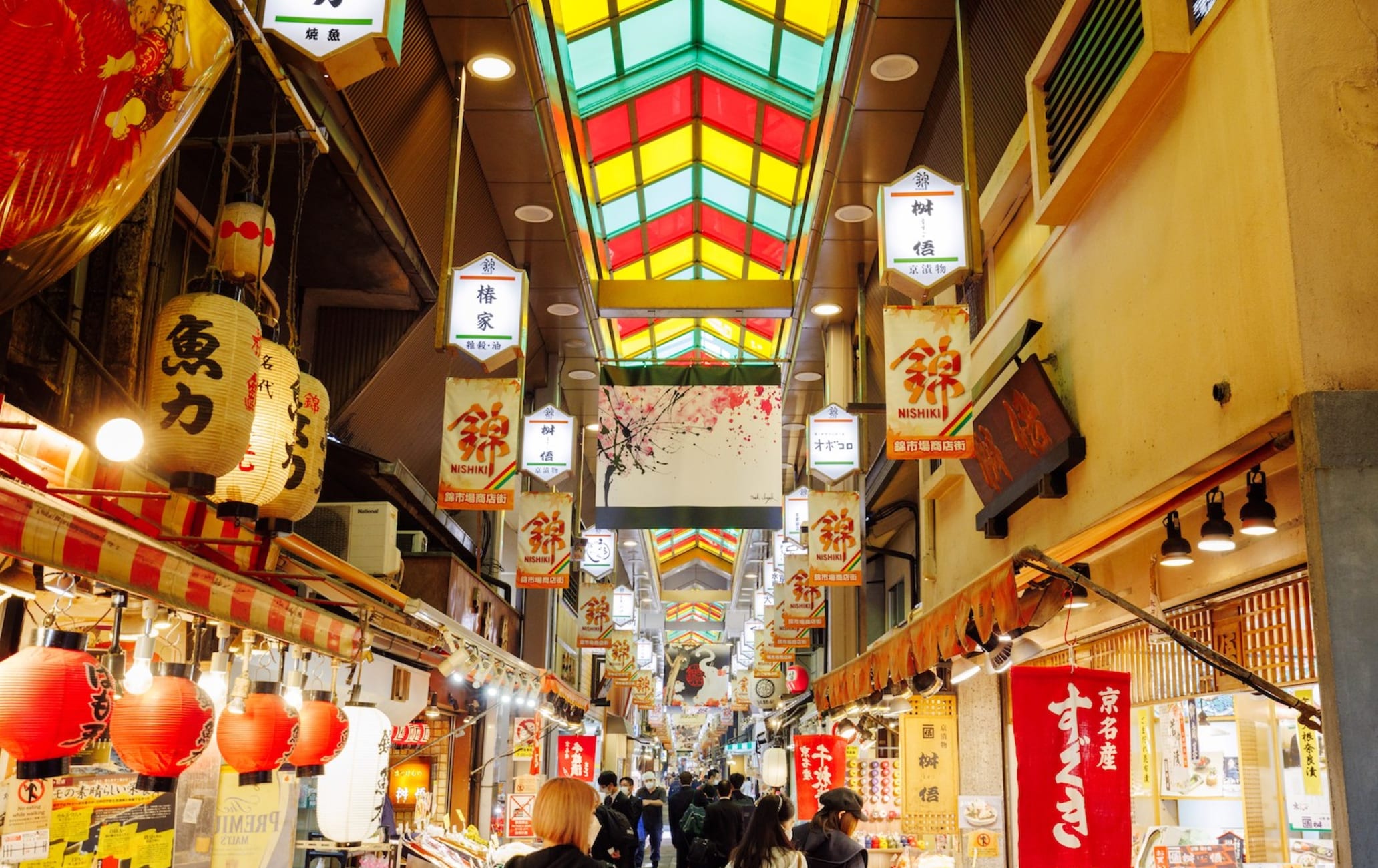
That is the pleasure of Nishiki Market. Neat slices of yellow omelette share counter space with grilled fish; pickles fill wooden barrels, and little handwritten labels rise out of heaps of dried seafood. Some things look immediately delicious. Others deserve a closer look before any promises are made.
It is easy to get distracted by the ready-to-eat food. Fried fish cakes are considerably easier to understand on an empty stomach than a bag of unfamiliar dried ingredients. But those crowded trays are worth looking at too—the different cuts, colours and preparations, the sheer amount of care tucked into something sold by the scoop.
“Kyoto’s Kitchen” feels rather fitting here. There is plenty to tempt you, plenty you recognise, and always something that makes you lean closer and ask, “What’s that?”

Kyoto’s Kitchen Is a Beautiful Mess
Kyoto can make lunch look almost too composed to touch: a small plate, a careful garnish, everything given room to look important. Nishiki shows the more crowded side of that appetite.
Here, the abundance is the attraction. Pale shavings rise in loose heaps, dark preserved seafood shines in shallow trays, and vegetables sit packed together in barrels. There is something lovely about seeing ingredients in quantities meant for cooking, not arranged three at a time with tweezers.
Look closer, though, and the apparent jumble becomes surprisingly orderly. Fish are lined up neatly. Different preparations have their own containers, scoops and handwritten labels. The display may leave you wondering what half of it is, but someone behind that counter knows exactly where everything belongs.
That feels familiar, even when the ingredients do not. Every serious kitchen has its own logic. Nishiki just lets the rest of us stand there admiring it—and occasionally mistaking an ingredient for a snack.
The Market Smells Like the Sea Even When Nothing Is Swimming
The seafood at Nishiki does not all arrive on ice. Some is dried, some salted, and some simmered until it turns dark and glossy. Tiny fish sit beside strips of seaweed and shellfish, with enough variation to make “What is that?” a perfectly reasonable recurring question.
Among these preparations is tsukudani: seafood, seaweed or other ingredients slowly cooked in a sweet-savoury soy seasoning. It is concentrated, often chewy, and intended to accompany rice in small amounts. That last detail matters. Something delicious beside a bowl of plain rice can be quite a conversation when eaten by the spoonful.
The dried ingredients have their own appeal: delicate shavings, firm strips, little fish with every detail still visible. Not everything conceals where it came from. Fair enough, although anyone who prefers dinner without eye contact may find certain trays easier to admire from a distance.
There is real pleasure in these less obvious foods. A little salt, sweetness or savoury depth can turn an ordinary bowl of rice into the part of lunch you keep returning to.
If It Can Be Skewered, Nishiki Has Considered It
A slice of rolled omelette looks reassuringly familiar. Beside it, a row of whole grilled fish makes a slightly different proposition. Both come on sticks, as though that settles the matter.
The displays are wonderfully tempting: browned edges, glossy sauce, pale curls of seafood and golden fish cakes lined up within pointing distance. There is something disarming about a small portion. A whole plate of an unfamiliar food invites deliberation. One skewer? Well, that seems manageable.
The pleasure is in how different those few bites can be. Soft layers of egg give way to the firmer chew of seafood; a fried fish cake has a springiness its crisp-looking surface does not quite prepare you for. Similar shapes, entirely different mouthsful.
And then there is the familiar negotiation: something you already know you like, or the thing you have been looking at for the last five minutes. Suddenly, two skewers seems perfectly reasonable.


Tako Tamago: Cute Was Never an Option
Tako tamago is difficult to overlook. Little red octopuses sit together in glossy piles, their arms curled around one another. Then you discover the quail egg tucked inside each one, and the display raises considerably more questions than it answers.
The preparation is less bewildering than the appearance: small octopuses simmered in sweet soy-based seasoning, with a peeled quail egg placed inside the mantle—the rounded part usually described as the head. That shine comes from the seasoning, not a candy coating.
There is a pleasing contrast between the springy octopus and the soft egg, with its mild yolk taking some of the emphasis away from the sweet-salty sauce. If you already enjoy octopus, the combination makes sense. It is simply presented with rather more anatomical honesty than a discreet slice in a seafood salad.
And if the entire little creature is a step too far, admiring the display is also a perfectly respectable relationship to have with it.

Fish Cakes Are Doing More Than Their Name Suggests
“Fish cake” is not the most persuasive introduction to something golden and freshly fried. It sounds like the sensible option. The one you choose after everyone else has ordered something interesting.
Satsuma-age deserves a better introduction. These cakes are made from finely ground, seasoned fish paste, shaped and deep-fried. Inside, the texture is smooth and springy rather than flaky; outside, there is a thin browned skin, not necessarily the crunchy coating the colour might suggest.
The additions make each version a little different. Vegetables bring sweetness or bite, cheese adds a creamy centre, and mochi introduces a soft, sticky chew. A plain one lets the fish flavour come through without much distraction.
There is something comforting about food like this: warm, savoury and satisfying in a few bites. It does not need the surprise of an egg hidden inside an octopus.
Although, apparently, a little cheese inside the fish is perfectly reasonable. I can follow that logic.
Mochi Has Too Many Personalities
One disappointing packaged mochi can do considerable damage to a relationship. Especially if it was cold, rubbery and apparently filled with sweet wallpaper paste. But that is a fairly small sample on which to dismiss an entire sweet counter.
A soft daifuku wraps a thin, stretchy layer of mochi around a filling, often red-bean paste. Kinako brings the warm, nutty flavour of roasted soybean flour—and a fine dusting down whatever you are wearing.
The skewered dumplings deserve their own name: dango. Usually made from rice flour, they are not simply little pieces of mochi. Grilled mitarashi dango, with its glossy sweet-soy glaze, offers a firmer chew and that lovely meeting of sweet, salty and lightly toasted.
Then come the seasonal leaf-wrapped sweets. Kansai-style sakura mochi has a tender, visibly grainy rice exterior and a salted cherry leaf that adds fragrance. Kashiwa mochi comes folded in an oak leaf, which is wrapping rather than part of dessert.
Similar ingredients, very different pleasures. Finding one you enjoy is much more appealing than being told you must try them all. Dessert already has a job. It does not need to become homework.
Nishiki Does Not Contain Only Kyoto
A sesame-covered dumpling does not become an old Kyoto recipe simply because you bought it in Nishiki. It can, however, become a very good reason to pause the conversation.
Goma dango belongs to the Chinese sesame-ball family known as jian dui: glutinous rice dough fried beneath a coating of sesame seeds, usually with a sweet filling. The appeal is immediate—a lightly crisp shell, a chewy middle and the roasted fragrance of sesame. Quite a lot happening in something that fits between two fingers.
These snacks sit comfortably alongside Japanese sweets and savoury foods. Markets have room for familiar favourites as well as regional specialities; appetite rarely observes the boundaries drawn by travel articles.
The distinction matters in the description, not as a test of whether you are allowed to enjoy your purchase. Kyoto has plenty of remarkable food of its own. It does not need to take credit for the neighbours’ dumplings.
Final Thoughts
There is something deeply enjoyable about a place that gives you so much to look at before you have even decided whether you are hungry. Nishiki has that effect. A neatly rolled omelette looks inviting, a barrel of pickles deserves another glance, and somewhere between the two, an unfamiliar ingredient becomes interesting enough to ask about.
Some foods will appeal immediately. Others may remain a photograph and a polite distance. Both are perfectly good outcomes. Curiosity does not require eating everything presented on a stick.
What makes Nishiki memorable is the food in all its different stages: ingredients waiting for a kitchen, preserved little extras for a bowl of rice, and something warm that barely makes it past the counter.
You can appreciate all of that and still leave thinking about the egg inside the octopus. Understandable. There was quite a lot to process there.


Leave a Comment