

Let me set a scene.
It’s not even 9 a.m. and Batu Caves is already wide awake. The air is thick and wet, carrying incense smoke up the rainbow stairs before you’ve even set foot on them. Families in bright saris and pressed shirts climb together, kids tugging at hems, everyone looking like they dressed to impress the gods. A woman glides past balancing a jug of milk on her head, not a single drop spilled, while a group of men chant softly as they climb, each step part of a ritual.
Monkeys weave in and out of the crowd, plastic bags firmly in their crosshairs. Pigeons swoop low, eyeing crumbs. The stairs themselves are patched and worn, some wooden, some slick from morning humidity, creaking under the weight of hundreds of feet. And towering over it all, Murugan, painted in impossible gold, glaring down like a gatekeeper to the climb.
This isn’t just sightseeing. This is sweat, incense, monkeys, milk jugs, and a staircase that’s older and more alive than it has any right to be.
Temple Cave (Cathedral Cave)
Everyone hypes up the 272 steps like it’s some rainbow-painted death march. Truth? If you’ve got a date with a stepmaster a few times a week, it’s nothing. While tourists were already wheezing and sitting mid-way, I just kept a steady pace, watching the show around me.
The stairs themselves creaked in places, wooden planks patched over stone, slick with the morning’s humidity. Locals floated past like it was a stroll, one woman balancing a jug of milk on her head for temple offerings without spilling a drop. Families climbed in full color — saris, bright shirts, kids tugging at hems — dressed, I assume, to impress the gods. The smell of incense drifted even here, curling up the staircase long before the shrines came into view.
And this was all before 9 a.m. — the place was alive already. Monkey gangs eyed every plastic bag, pigeons swooped low looking for dropped food, and vendors below called out, frying snacks for the late risers.
At the top, the ceiling arched a hundred meters above me, sunlight pouring in like a spotlight, shrines glowing in the haze. Limestone walls wept with condensation, pigeons scattered in bursts, and the whole cavern smelled of oil lamps, fruit offerings, and a tang of bat guano. Chaotic? Absolutely. Breathtaking? Even more so.
The descent was its own theater: city views stretching out, Murugan’s golden back gleaming, and the steady rhythm of feet on worn stairs.
Ramayana Cave – Neon Myth & Glow-Paint Gods
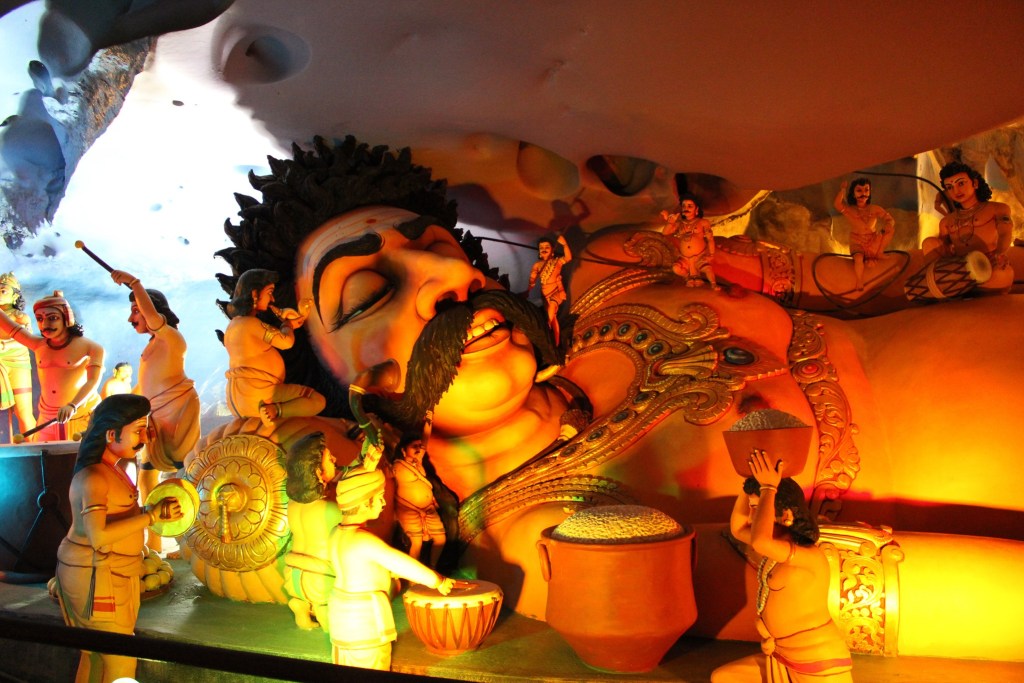
Tucked to the side of the main complex, past the towering green Hanuman statue glaring like he’s about to judge your life choices, sits the Ramayana Cave. Step inside and it’s like walking into a myth retold by someone with a glow-stick obsession.
The walls are lined with psychedelic dioramas of the Ramayana — gods, demons, warriors all frozen mid-battle, painted in impossible colors, lit with flickering tubes that hum louder than the pigeons outside. There’s Ravana with his ten heads, Kumbhakarna the eternal sleeper, and Hanuman mid-leap, his tail coiled in neon light. It feels less like a temple and more like stepping into a storybook someone forgot to turn off from carnival mode.
The air is cooler here, damp limestone underfoot, incense still clinging to your clothes from the climb. It smells faintly of wax and dust, and every corner has something new to gawk at — a demon snarling, a god glowing, a tableau of myth that looks part holy, part theme park.
Why it hits: After the solemnity and sweat of the Temple Cave, Ramayana Cave is pure spectacle. It doesn’t whisper spirituality; it shouts in neon. And honestly? It’s weirdly perfect that way.
Pro Tip: Save it for after the main climb. It’s shaded, surreal, and makes for the kind of photos that look like you hallucinated a Hindu epic.
Hours: 09:00–18:00 (roughly)
Fee: Around RM5–15 depending on the mood at the gate (bring small notes).

Cave Villa – The Ugly Side
Most guides sell Cave Villa as “colorful culture.” Reality? It’s a fluorescent nightmare with animals paying the price.
Inside, the limestone corridors are lined with glass boxes — snakes curled under heat lamps, tarantulas stuffed in plastic tubs, turtles swimming circles in tanks too small to turn. Families shuffle past, kids squeal, cameras flash. But stay still for a minute, and the truth punches through.
I watched a tiny sugar glider trapped in a glass tub, its food dish swarmed by red ants. Every time it tried to eat, the ants bit. It squeaked, flinched, then tried again. Hunger versus pain. That sound still sticks.
In another tank, a turtle sat cramped in filthy water, its shell scraping the sides, coins and plastic notes thrown in like some twisted wishing well. People tossed more money in, smiling, as if luck can be bought by choking a turtle in spare change.
The smell was damp stone, ammonia, and despair. This isn’t conservation. It isn’t education. It’s spectacle at the expense of living beings.
Sudrabfox take: Don’t feed it. Don’t fund it. If you’re at Batu Caves for the color, the culture, the limestone, and the rituals — keep your ringgit in your pocket here. Sometimes the most respectful thing a traveler can do is walk away.
I wanted to remind you, that not all animals are free and happy. And I would suggest, that you before going to an any kind of animal involved entertainment. Stop and think for a moment. Is that animal happy there, is it in such environment for it own protection, or is it just used for money.


Muzium Orang Asli – Culture Without the Circus
After the chaos of Batu Caves, we detoured about 9 km further to the Muzium Orang Asli in Gombak. No neon lights, no animals trapped in glass — just two quiet floors dedicated to Malaysia’s indigenous peoples, the Orang Asli.
The building itself is plain, almost forgettable from the outside, but step in and it’s a different rhythm entirely. Displays of woven baskets, blowpipes, beadwork, and tools are laid out with care. There are photographs, stories of migration, and maps of the peninsula. You get a sense of culture that’s lived, not packaged.
The air inside is cool, dust motes floating in shafts of sunlight, the smell faintly of polished wood and old paper. No vendors shouting, no monkeys lunging for your bag — just silence and space to actually learn. It was such a contrast that it felt like we’d crossed into another world: here, culture preserved respectfully, not sold off as spectacle.
Why You’ll Love It:
Because sometimes the most underrated spots are the ones that don’t scream for attention. The museum gives you context for the land you’re walking on — history, craft, and people who’ve been here long before the rainbow steps and golden statues.
Practical bits:
- Hours: 09:00–17:00, closed Fridays.
- Fee: Free.
- Address: KM 24, Jalan Pahang Lama, Gombak.
- Getting there: Easy Grab ride from Batu Caves (~15–20 min).
Pro tip: Pair it with your Batu trip if you want balance — chaos in the morning, quiet reflection in the afternoon.
Final thoughts
Batu Caves was never just about the rainbow stairs. The climb was fine — stepmaster legs carried me up while others wheezed, and the view from the top was worth every drop of sweat. The shrines glowed, the incense clung to my clothes, and the whole place pulsed with ritual and color before 9 a.m. That part was breathtaking.
But then there was Cave Villa. And that’s the part I can’t file away neatly.
The image burned into me isn’t Lord Murugan gleaming in gold or the limestone arch above the temple. It’s that sugar glider in a glass box, squeaking every time a red ant bit it, desperate enough to keep trying to eat anyway. In the wild, it would have glided off into the night, searching for food under the trees. Here, it was stuck in a plastic tub, battling ants instead of flying free.
Even my father — not the type to rattle easily — stood there, shook. Neither of us said much, because what do you say when you watch an animal reduced to that?
Then there was the turtle — cramped in water too shallow, swimming in circles under a blanket of coins and plastic notes people had thrown in “for luck.” Luck for who? Definitely not for the turtle choking on spare change.
Travel isn’t always pretty. Sometimes it hits you in the gut. Batu Caves gave me both: the wonder of shrines carved into stone older than empires, and the horror of lives boxed up for tickets and tips.
If there’s one takeaway from Day 4, it’s this: climb the stairs, breathe in the incense, watch the morning rituals. But when you see animals caged, coins tossed at turtles, or a sugar glider squeaking under ants — don’t just look away. Think about what your money funds. And maybe choose not to pay for cruelty packaged as entertainment.
That’s the scribble that stayed with me.


2 Comments