

Let me set the scene.
The table is plastic, the chair has seen things, and the fan above you is moving hot air around with great enthusiasm and almost no practical effect.
Somewhere three stalls down, a cleaver is hitting a chopping board hard enough to cut through every conversation in the room. A wok flares. Someone shouts an order number. Coffee smells dark and sweet. Fried garlic hangs in the air. One tray goes past carrying chicken rice so pale it looks almost suspicious. Another has laksa the colour of a minor emergency. Somebody at the next table is already halfway through a plate of noodles while you are still trying to work out which queue belongs to which stall.
Welcome to Singapore food culture. Not one cuisine. Not even close.
Chinese techniques sit beside Malay flavours. Indian-Muslim food shares space with Peranakan dishes. Coconut milk, soy sauce, sambal, curry leaves, pork stock, pandan, dried shrimp, chilli, coffee and condensed milk all somehow coexist under the same fluorescent roof without anybody feeling the need to explain the arrangement.
That is the clever part.
Singapore did not produce one neat national cuisine and hand it over in a tidy bowl. It built a dining culture from migration, trade, religion, adaptation, neighbourhood habits and generations of people cooking beside each other long enough for boundaries to get interesting.
And the best place to see that is not necessarily in a polished restaurant. It is here.
At a hawker centre where one family orders from three different stalls, somebody has reserved a seat with a tissue packet, a queue is forming for one very specific plate of noodles, and your lunch may cost less than the drink you bought at the airport.
The food comes fast. The history underneath it did not. So instead of another list of “must-eat Singapore dishes,” this is a look at what these plates are actually telling you.
Because in Singapore, lunch is rarely just lunch.
First: Singapore “Street Food” Mostly Left the Street
Here is the slightly awkward truth about Singapore street food:
Most of it is not actually on the street anymore.
The hawker tradition started exactly where you would expect — carts, roadside stalls, makeshift setups, people selling cheap meals wherever foot traffic was good enough to make a living. By the 1960s, that system had also accumulated the less romantic bits: poor access to clean water, waste problems, traffic obstruction, licensing issues, and the occasional public-health nightmare nobody puts on a heritage poster.
So the government did not loosen the rules. It tightened them.
From the late 1960s onward, street hawkers were registered, licensed, and progressively moved into organised food centres. Between 1971 and 1986, roughly 18,000 hawkers were relocated into purpose-built markets and hawker centres with proper water, drainage, electricity and fixed stalls.
And somehow, the food culture survived the relocation. It just acquired tables. Plastic ones, usually.
Instead of chasing a pushcart down a roadside, you now stand under a roof staring at thirty stalls while your brain quietly gives up on making a decision. Chicken rice beside nasi lemak. Prata beside noodles. Kopi being poured somewhere behind you. Someone reserving a seat with a tissue packet while you are still trying to understand whether that is genuinely a thing.
It is.
The hawker centre became more than a cleaner place to put food sellers. It became part neighbourhood dining room, part social meeting point, part daily survival system for people who do not intend to cook every meal themselves. Singapore’s National Environment Agency still describes hawker centres as community dining spaces providing affordable everyday food, and in 2020 Hawker Culture in Singapore was added to UNESCO’s Representative List of the Intangible Cultural Heritage of Humanity.
So when people say “Singapore street food,” nobody needs to start an argument over vocabulary.
Just know what you are actually looking for.
Probably a hawker centre. Probably fluorescent lighting. Definitely better food than the furniture suggests.
Chicken Rice: The Dish That Looks Too Plain to Be This Serious

Chicken rice is the kind of plate that arrives looking almost offensively modest.
Pale chicken. Pale rice. A few slices of cucumber. Tiny dish of chilli.
Maybe a bowl of clear broth sitting beside it looking like it has wandered in from somebody else’s lunch.And yet Singapore has somehow turned this beige little arrangement into one of its most recognisable dishes.
The mistake is focusing only on the chicken.Good Hainanese chicken rice lives or dies by the rice.
It is cooked with chicken fat and stock, usually with ginger, garlic and pandan, so every grain carries flavour before anything else touches the plate. The National Heritage Board describes modern Singapore chicken rice as the result of Hainanese roots mixed with Cantonese cooking techniques and local ingredients — exactly the sort of culinary borrowing Singapore does extremely well.
The chicken itself is traditionally poached until tender, then cooled so the skin stays soft and slightly gelatinous rather than turning dry and tight. Roasted and soy-sauce versions exist too, but poached chicken is still central to the classic Hainanese style.
Then everything around it starts doing small but important jobs.
The chilli brings heat and acidity. Ginger cuts through the richness. Cucumber cools things down. The broth uses what would otherwise be leftover chicken stock. Nothing on the plate needs to shout because everything already knows what it is supposed to be doing.
Which is why bad chicken rice is so easy to spot. If the rice tastes like ordinary white rice, something has gone wrong. If the chicken is dry, the chilli cannot rescue it.
And if you are judging the dish by how exciting it looks in a photograph, you have already wandered into the wrong argument.
Chicken rice is not trying to impress you from across the room. It waits until the first spoonful. Then the rice explains everything.
Kaya Toast + Kopi: Singapore Breakfast Is Quietly Complicated

Kaya toast looks harmless. Thin toast. Sweet coconut jam. Butter. Coffee. Two soft-boiled eggs wobbling nearby. Nothing on that tray suggests you are about to encounter one of Singapore’s more specific food rituals. Then somebody asks how you want your kopi. And breakfast develops grammar.
The traditional set is usually built around toast spread with kaya — a jam made from coconut milk, eggs and sugar — paired with butter, soft-boiled eggs and Hainanese-style coffee or tea. Singapore’s National Heritage Board traces this “Nanyang breakfast” to Hainanese migrant communities, especially from the nineteenth century onward, with influences from European cooking and local Southeast Asian ingredients.
The toast itself is all contrast.
Crisp bread. Soft kaya. Cold or semi-firm butter beginning to surrender to the heat. Sweet coconut and pandan.
Then you crack the eggs into a small dish, add soy sauce and white pepper, and suddenly breakfast has gone from neat little toast triangles to something far messier and better.
The coffee is where newcomers usually discover that Singapore has no interest in making ordering unnecessarily intuitive.
Kopi comes with condensed milk.
Kopi-O drops the milk.
Kopi-C uses evaporated milk instead.
Then you can start adjusting sweetness with siew dai, remove sugar with kosong, or combine terms until your breakfast order sounds suspiciously like a password.
You do not need to memorise the entire system before sitting down.
You just need to know there is a system.
Traditional kopi itself is darker and more aggressive than polite café coffee. Beans are roasted with sugar and traditionally margarine, then brewed through a cloth filter and poured between long-spouted pots. That roasting method gives it the dense, caramelised edge that can stand up to condensed milk without disappearing completely.
And this breakfast tells the same Singapore story as the heavier hawker dishes, just much more quietly. Hainanese migrants. European influences. Malay language. Local coconut and pandan. Coffee-shop culture. All compressed into toast, eggs and a glass of very serious coffee. It looks simple.The history underneath it has other plans.
Char Kway Teow: Smoke, Lard, Cockles, Zero Interest in Being Light
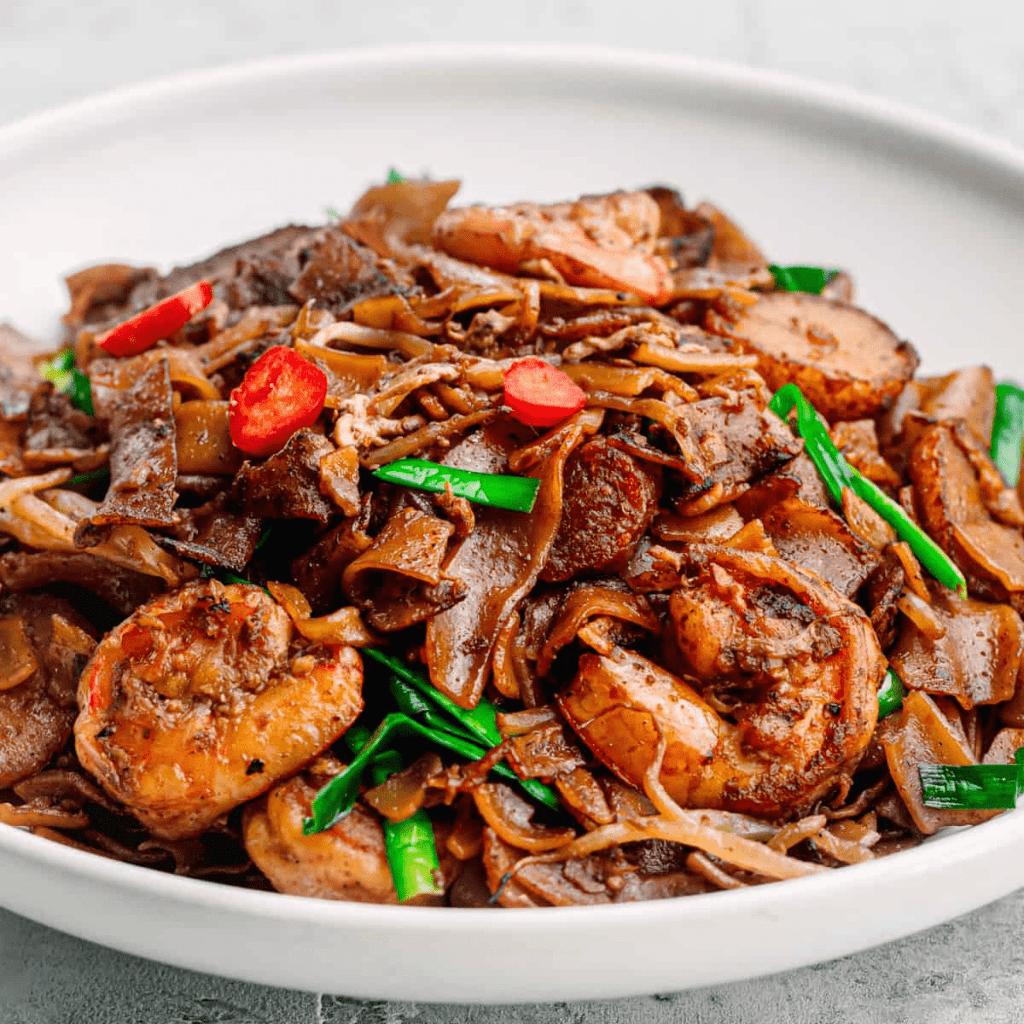
Char kway teow does not arrive pretending to be virtuous. Flat rice noodles hit a screaming-hot wok with yellow noodles, egg, prawns, cockles, Chinese sausage, garlic, dark soy and, traditionally, lard. The whole thing gets thrown around at high heat until the noodles pick up that smoky edge known as wok hei — the breath of the wok.
That smoke matters. Without it, you have noodles wearing dark sauce.With it, the dish suddenly has depth. Sweet from the soy. Salty. Greasy in exactly the way it is supposed to be. A little briny from the cockles.
Then the Chinese sausage comes in with that dense, slightly sweet chew and reminds you this plate was never designed around restraint.
Historically, char kway teow began as cheap, filling food for manual labourers. Over time it accumulated more ingredients, more richness, and enough variations to start arguments across Singapore and Malaysia about whose version does what better. Singapore’s version commonly uses both flat rice noodles and yellow noodles, while the darker sauce gives it a deeper colour than some regional styles.
The real skill sits behind the wok.
High heat is unforgiving. Leave the noodles too long and they burn. Move too slowly and they turn heavy. Crowd the wok and the smoke disappears. The National Heritage Board notes that proper wok-hei technique takes real training, which is one reason this is not the dish where “just fry some noodles” gets you very far.
And please do not ask it to be light. Char kway teow has heard your concerns. It has chosen lard anyway.
Chilli Crab: Famous, Messy, and Not Your Cheap Hawker Lunch

Chilli crab has one major branding problem. People hear “Singapore street food” and assume this is another inexpensive hawker-centre plate you casually pick up between noodles and kopi.
It is not.
Chilli crab is usually found at seafood restaurants and tze char places, not handed over in a paper wrapper for pocket change. Singapore’s National Heritage Board specifically places the dish in seafood restaurants and local cooked-food establishments today.
And once it arrives, subtlety is over. Whole crab. Thick red sauce. Shell crackers. Fingers immediately involved. Fried or steamed mantou waiting nearby because leaving that sauce on the plate would be a serious failure of judgment.
The dish appeared in Singapore in the mid-1950s, when Cher Yam Tian began adding chilli sauce to stir-fried crab and selling it from a pushcart in Kallang with her husband. The success of that simple version eventually led to Palm Beach Restaurant in 1962, while later cooks pushed the sauce toward the richer style most people recognise now.
That modern sauce is the real personality.
Sweet. Savoury. Spicy rather than brutally hot. Thick enough to cling to the shell. Often enriched with egg, which gives it that glossy, almost silky texture instead of turning the whole thing into tomato sauce with anger issues. The addition of sambal and egg came through later restaurant adaptations rather than the original pushcart recipe.
Then comes the practical reality. You are cracking shells covered in sauce.You are pulling meat out with your fingers.You are dipping mantou into whatever is left.At some point, the distinction between “eating neatly” and “accepting your fate” disappears completely. And that is probably how chilli crab should be eaten.
It is communal. It takes time and is significantly more expensive than your chicken rice. And It will very likely put sauce somewhere you did not intend. But pretending it belongs in exactly the same category as a five-minute hawker lunch does the dish no favours.
This is not quick food. This is dinner with consequences.
Hokkien Mee: The Ugly Noodles With Excellent Priorities

Hokkien mee is not winning a beauty contest.
The noodles are pale, glossy, slightly tangled, and usually arranged on the plate with all the visual ambition of laundry dumped on a chair.
Excellent.
That means you can stop looking at it and actually pay attention to what matters.
Singapore-style fried Hokkien mee uses a mix of yellow wheat noodles and bee hoon, usually with prawns, squid and pork, then builds most of its flavour from stock rather than sauce. The noodles are fried, loosened with rich prawn or pork-bone broth, and left to absorb it until they become savoury all the way through rather than simply coated on the outside.
That stock is the whole trick.
At Swee Guan, one of the old-school examples still documented by Singapore’s National Heritage Board, the noodles are cooked over charcoal and repeatedly drizzled with pork-bone soup that has been simmering for hours. That combination of smoke, fat and absorbed broth is why a good plate tastes much deeper than its colour suggests.
Some versions arrive fairly dry. Others are wetter, almost slick with stock. Either way, you want the noodles to taste like something before the sambal gets involved.
Then the extras start pulling their weight.
Prawns bring sweetness. Squid adds chew. Sambal wakes everything up.
Calamansi or lime cuts through the richness at the end. And suddenly that aggressively beige plate has managed to become smoky, briny, savoury, slightly sweet and sharp all at once. It is also a very Singapore kind of dish.
Hokkien cooking arrived with Chinese migrants, then changed through local ingredients, hawker technique and decades of adaptation. Singapore’s heritage records specifically note how Chinese regional cuisines evolved after migration rather than remaining frozen replicas of what existed in China.
Which is probably why Hokkien mee does not waste much energy looking photogenic. It already has enough work to do.
Roti Prata: The Soundtrack Is Half the Meal

Roti prata starts making noise before it becomes food. Dough hits the counter. Hands stretch it thinner and thinner until it looks like it has one bad decision left before becoming transparent.
Then it gets folded, slapped onto a hot griddle, and fried until the outside turns crisp while the inside stays soft, chewy, and layered enough to soak up curry without immediately surrendering. Singapore’s National Heritage Board traces prata to South Asian flatbread traditions, adapted locally through Indian-Muslim food culture.
That texture is the whole point. The edge should crack. The middle should pull.The curry should disappear into the soft layers fast enough that waiting politely becomes pointless.
Plain prata is already enough when the dough is good. Then Singapore does what Singapore usually does and starts adding options. Egg. Onion. Cheese. Mushroom. Banana.Chocolate. At some stalls, the menu reads less like breakfast and more like someone testing the structural limits of flour.
And somehow, most of it still works. The classic version is usually served with curry, often fish or dhal, and the combination is beautifully unfair: crisp bread, soft centre, hot gravy, spice, oil, and enough texture to make knife-and-fork behaviour feel unnecessarily formal.
Then there is murtabak, the heavier relative. Same general family, but stuffed with egg, onion, meat and spices before hitting the griddle. Bigger, denser, messier, and much less interested in pretending this is a light snack. Roti prata also ignores normal meal boundaries.
Breakfast. Supper. Middle of the night. Post-drinks. Random Tuesday at 4 p.m. Nobody seems particularly concerned. Which is probably correct. Some foods are meals. Prata is more of a recurring event.
Nasi Lemak: Breakfast That Refused to Stay in the Morning

Nasi lemak looks deceptively organised. Rice in one corner. Sambal in another. Ikan bilis and peanuts sitting politely together. Cucumber doing its best to convince everyone there is something refreshing happening here.
Then the fried chicken arrives and the whole plate loses interest in restraint.
The heart of the dish is the rice. It is cooked with coconut milk and pandan leaves, which gives it that soft, fragrant richness before anything else joins the plate. The name literally means “fatty rice” in Malay, and Singapore’s National Heritage Board traces the dish to Malay food traditions, where coconut and anchovies were both easy, practical ingredients.
Everything around it works by contrast. The sambal is sweet, spicy and slightly fermented from belacan. Ikan bilis bring salt and crunch. Peanuts bring more crunch. Cucumber cools the mouth down. Egg softens everything.
Then depending on the stall, fried chicken, fish, otah, luncheon meat or curried vegetables may join the plate and turn breakfast into something considerably more ambitious. And yes, breakfast is where nasi lemak started. It just did not stay there.
In Singapore it is now eaten at breakfast, lunch, dinner and supper, which feels entirely reasonable once you have tasted coconut rice next to sambal and realised clocks are not contributing much to the discussion.
Different communities have also built their own versions over time. Malay-style plates tend to stay closer to fried chicken or fish, egg, sambal and the classic accompaniments, while Chinese-style nasi lemak stalls may add sausages, fish cakes, luncheon meat and curried vegetables.
That flexibility is part of why the dish fits Singapore so well. The basic structure survives. Everything around it negotiates. Just do not treat the sambal like decoration. The rice may be the foundation, but the chilli is usually where the plate stops being polite.
Laksa: The Bowl Where Cultures Stop Staying in Their Lanes

Laksa is where Singapore’s food history stops pretending anything developed in a straight line.
The bowl arrives loud. Orange-red broth. Coconut milk. Dried shrimp. Prawns. Fishcake. Chilli. Laksa leaves.
Thick rice noodles sitting underneath all of it, carrying a broth that should be rich without turning into coconut cream with ambitions. Singapore’s National Heritage Board describes laksa as a dish shaped by Chinese, Malay and other regional influences, with especially strong ties to Peranakan food culture.
That mix is the whole point.
Chinese cooking methods met Southeast Asian spices and ingredients. Peranakan kitchens pushed those combinations further. Different communities adapted the dish again, and Singapore ended up with its own variations rather than one neat ancestral recipe preserved under glass.
Katong became especially associated with laksa, partly because the neighbourhood had a strong Peranakan community and developed its own cluster of famous stalls.
And Katong laksa has one tiny detail I love because it says more than another paragraph of food-history poetry ever could. The noodles are often cut short. Very short. Short enough that you can eat the whole bowl with a spoon instead of fighting long rice noodles with chopsticks while broth attempts to redecorate your shirt.
Practical adaptation wins again.
Taste-wise, the first hit is usually creamy, salty and deeply savoury rather than simply hot. Then dried shrimp pushes through. Chilli follows. Laksa leaf gives the broth that sharp herbal edge that stops the coconut milk from becoming heavy. Everything is happening at once, but nothing should disappear. That is good laksa. Not tidy. Not one tradition or particularly interested in choosing sides. Which, frankly, makes it a very Singapore bowl of noodles.
Satay: Follow the Smoke

Satay is one of those foods you usually smell before you see it. Charcoal first. Then sweet marinade hitting heat. Then the fat. And suddenly you are following a trail of smoke through a hawker centre like your dignity was never part of the plan.
The basic idea is simple: small pieces of meat skewered, grilled over charcoal, and served with peanut sauce, cucumber, onion and compressed rice cakes known as ketupat. In Singapore, satay is strongly tied to Malay and Javanese food traditions, and the dish has been sold by itinerant hawkers here for generations. Singapore’s heritage records also connect its history to famous gathering spots such as the old Satay Club.
The simplicity is deceptive. Good satay depends on the balance between marinade, fire and timing. Too little char and it tastes flat. Too much and you have meat-flavoured charcoal. The sweet marinade needs enough heat to caramelise at the edges without burning completely, while the meat should stay juicy inside. That is why the grill matters just as much as the sauce.
And then there is the peanut sauce.
Thick. Nutty. Sweet. Spicy. Usually good enough to make the cucumber feel like administrative paperwork. The best part is that satay does not need much explanation once it hits the table. You pull the meat from the skewer.
Dip. Eat. Repeat. The whole thing works on instinct. It also changes the mood of the hawker centre around it. Daytime food can be all efficiency: tray, lunch, move on. Satay feels more like evening. Smoke hanging in the air.
Skewers arriving in piles. People sharing plates. Someone ordering another round because apparently the first twenty sticks were only a preliminary investigation. And that is probably the clearest practical advice here: If you can smell charcoal and sweet meat from halfway across the food centre, you are already close.
The Hawker Centre Has Rules Nobody Puts on the Menu
A hawker centre looks gloriously informal until you accidentally sit at somebody else’s table. That lonely tissue packet? Probably not rubbish.
In Singapore, chope means reserving a seat, and people commonly do it with tissue packets, umbrellas, office passes or whatever harmless object they are willing to leave behind. The habit is so embedded that the National Environment Agency had to clarify in 2025 that no, people are not being fined for doing it.
So before dropping yourself into the first empty chair you see, look at the table properly. A tiny packet of tissues can carry an astonishing amount of authority.
Then there is payment.
Singapore has pushed hawker centres hard toward digital transactions, and SGQR is now widely used across participating stalls. But “widely used” does not mean “every single auntie with a wok accepts whatever foreign payment app you happen to possess.” Cash is still worth carrying, especially if you are moving between older stalls or smaller food centres.
And after eating, take your tray back. This one is not cultural folklore.
Since 2021, diners at hawker centres have been required to return used trays and crockery and clear litter from the table. First-time offenders who ignore enforcement officers can receive written warnings; repeat offenders may be fined or taken to court.
Which makes the entire routine fairly simple. Spot the table. Check for tissues. Order from however many stalls your appetite thinks is reasonable. Pay. Eat. Return the tray. No ceremonial initiation required.
Just do not throw away somebody’s tissue packet before lunch and then leave your own chicken bones behind afterward. That would be a remarkably efficient way to misunderstand both ends of the system.
Do Not Queue Just Because Somebody on TikTok Told You To
Singapore has enough famous stalls to turn lunch into crowd management. Some queues are deserved. Some are habit or exist because fifty people watched the same video before breakfast.
The problem starts when the queue itself becomes proof that the food must be worth it. That logic gets shaky very quickly in a city where the 2026 Michelin Bib Gourmand list alone includes 97 establishments, and 73 of those are classified as street food.
That is a lot of competent cooking for one lunch hour. So if one stall has a forty-minute queue, look around before emotionally committing. What are nearby tables actually eating? Which stall is turning plates over quickly?
Is one cook making one dish over and over rather than juggling fifteen unrelated things? Are locals queueing too, or are you standing inside a small convention of people who all read the same recommendation? None of those clues guarantee brilliance.
But they tell you more than follower count. Michelin can be useful. Long queues can be useful. Awards, reviews and famous names can all point you somewhere worth trying. They are just not commandments.
Singapore is one of the worst places to waste an entire meal slot because the internet convinced you only one stall knows how to fry noodles. Sometimes the queue is telling you something. Sometimes it is just very good marketing with lunch attached.
The Real Singapore Dish Is the Hawker Centre Itself
If you want one plate that explains Singapore, you are going to be disappointed. There is not one. That is the point. Look around any decent hawker centre and the argument is happening in real time. One table has chicken rice.
The next has nasi lemak. Somebody is tearing prata into curry. A bowl of laksa is steaming three seats away. An uncle is drinking kopi slowly enough to suggest he has absolutely nowhere urgent to be. An office worker is eating Hokkien mee at a speed that suggests the opposite.
And somehow all of this belongs in the same room.
Singapore’s National Environment Agency describes hawker centres as community dining spaces and a reflection of the country’s multicultural society, which sounds very official until you sit inside one and realise they are basically describing lunch.
Chinese, Malay, Indian, Peranakan and other food traditions are not arranged into neat museum displays here. Think of them like they are neighbours that share tables. Compete for queues. Borrow ingredients and adapt to local tastes.
They become breakfast for one family and supper for another. That everyday mixing is more interesting than trying to crown one dish as “the taste of Singapore.” Because the real thing is not chicken rice. It is not laksa or chilli crab.
It is the person at the table who ordered from three different stalls because apparently choosing one cuisine for lunch was an unnecessary limitation.
A hawker centre lets all of those histories sit beside each other without forcing them into one tidy national recipe. Which feels about right.Singapore food is not one flavour. It is an extremely organised argument happening over plastic tables.
Final Thought
You finish eating. The plate is streaked with chilli oil. The kopi glass is sweating onto the table. Someone at the next stall is shouting an order number.
A family beside you has somehow assembled lunch from four different cuisines without treating that as remotely unusual.
Then somebody stands up. You pick up your tray. Another person takes the seat almost immediately. That is probably the cleanest way to understand Singapore hawker food.
Not as a collection of “iconic dishes.” Not as a checklist where chicken rice earns one tick, laksa earns another, and chilli crab gets dragged in because every travel article says it must. The interesting part sits underneath all of that.
Migration. Trade. Religion. Colonial history. Family recipes. Government planning. Neighbourhood habits. Ingredients travelling between communities. Cooking methods changing because the climate, customers, equipment or available produce changed with them.
All of that history gets compressed into meals people still eat because they are hungry, late for work, meeting family, avoiding cooking, or simply know exactly which stall makes their noodles properly. That ordinary part matters. Hawker food survived because it stayed useful. It fed workers and fed families.
It moved from roadside carts into organised centres. Without losing the habit of putting several different food traditions within shouting distance of each other.
And today you can sit under a ceiling fan, spend surprisingly little money, and eat something carrying several generations of Singapore history without anybody delivering a lecture alongside it.
Good. The food can handle the storytelling itself.


me spicy food lovers. I wanna try chili crab. thank you for sharing for my reference for next trip
it’s on my top 10 list of foods I eat each time I’m in Singapore 😉